
The Real Cost of Not Investing in Digital Transformation
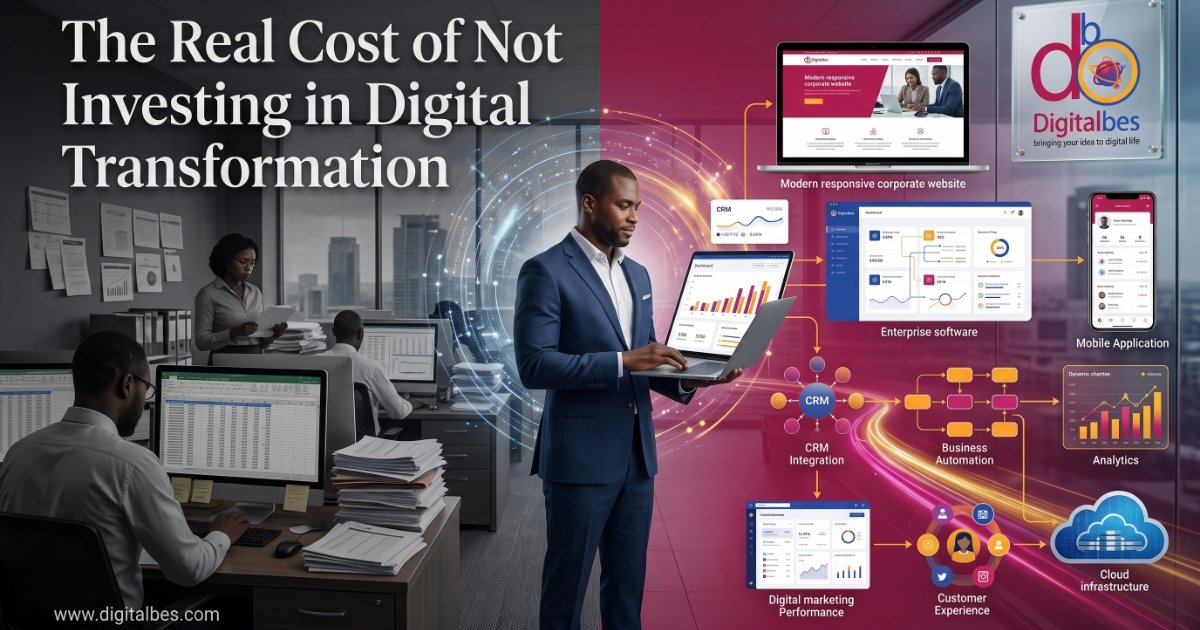
The Real Cost of Not Investing in Digital Transformation
Many businesses focus heavily on the cost of implementing technology.
Questions such as:
How much will the software cost?
How much should we spend on a website?
Is this automation project worth the investment?
Can we postpone digital transformation until next year?
are common in boardrooms and management meetings.
However, very few organisations stop to ask a far more important question:
What is the cost of doing nothing?
While businesses carefully evaluate technology investments, many fail to calculate the financial and operational impact of maintaining inefficient processes, disconnected systems, and outdated customer experiences.
In today's increasingly digital business environment, the cost of standing still is often much higher than the cost of innovation.
Lost Customers You Never Knew Existed
Most buying journeys now begin online.
Potential customers often research products and services before speaking to a salesperson.
If your digital presence is weak, prospects may never reach out.
Common issues include:
❌ Outdated websites
❌ Slow loading pages
❌ Poor mobile experiences
❌ Missing online enquiry systems
❌ Weak search visibility
❌ Lack of trust-building content
The result?
Potential customers move to competitors who offer a more professional digital experience.
Businesses frequently assume they are losing customers because of pricing or competition when the real problem may be their digital presence.
Every missed enquiry represents revenue that may never be recovered.
Productivity Loss Across The Organization
Many companies continue to rely on:
Multiple spreadsheets
Repeated data entry
Email-based approvals
Manual reporting
Paper-based workflows
At first glance these processes may seem manageable.
However, when employees spend hours performing repetitive tasks, the cost accumulates quickly.
Consider:
Time spent searching for information
Time spent correcting errors
Delayed approvals
Duplicate records
Inconsistent reporting
The hidden cost is not only operational.
It also affects employee satisfaction and productivity.
Digital transformation allows businesses to automate repetitive processes and allow teams to focus on higher-value activities.
Slower Business Decisions
Modern organisations depend on timely information.
Leadership teams must make decisions regarding:
Sales performance
Customer behaviour
Financial performance
Service delivery
Operational efficiency
Without connected systems, obtaining accurate information often becomes difficult.
Executives may rely on outdated reports, fragmented spreadsheets or incomplete data.
This creates delays in decision-making.
Businesses that leverage integrated technology platforms are often able to make decisions faster because information is available in real time.
Speed has become a competitive advantage.
Businesses that move faster often adapt more successfully to changing market conditions.
Security Risks Continue To Grow
As business operations become increasingly digital, cybersecurity can no longer be treated as an afterthought.
Outdated systems and poorly maintained infrastructure create vulnerabilities such as:
Data breaches
Ransomware attacks
Unauthorized access
Service disruptions
Data loss
The cost of a security incident can be significant.
Potential impacts include:
❌ Operational downtime
❌ Financial losses
❌ Regulatory issues
❌ Customer distrust
❌ Reputational damage
Investing in secure, scalable and actively maintained systems helps organisations reduce risk and improve resilience.
Customers Now Expect Digital Convenience
Customer expectations have changed dramatically.
Modern customers want the ability to:
✅ Access information instantly
✅ Request services online
✅ Make payments online
✅ Learn online
✅ Receive updates automatically
✅ Track progress digitally
Companies that continue relying entirely on offline interactions often struggle to meet these expectations.
The result is increased customer frustration and reduced competitiveness.
Digital transformation is not simply about technology.
It is about improving the customer experience.
Businesses that provide convenience are often more likely to retain customers and generate referrals.
Growth Becomes More Difficult
As businesses expand, complexity increases.
More customers.
More employees.
More processes.
More transactions.
Without scalable systems, growth begins to create operational challenges.
Business owners often discover that existing tools can no longer support increasing demand.
Common challenges include:
Poor reporting visibility
Limited scalability
Process bottlenecks
Disconnected applications
Inefficient workflows
Digital transformation creates a foundation that can support future growth rather than restricting it.
Competitors Continue Moving Forward
While some organisations postpone transformation projects, others continue investing in:
Better websites
Customer portals
Business automation
Custom software
Digital marketing
Enterprise platforms
Data-driven decision making
These investments often improve:
✅ Efficiency
✅ Customer engagement
✅ Brand perception
✅ Service delivery
✅ Revenue opportunities
The competitive gap gradually widens.
What begins as a small disadvantage can become a significant challenge over time.
Digital Transformation Is No Longer Optional
Digital transformation should not be viewed as a technology project.
It should be viewed as a business growth strategy.
The goal is not simply to buy software.
The goal is to create a connected digital ecosystem that helps the organisation:
Serve customers more effectively
Improve productivity
Increase visibility
Make better decisions
Scale sustainably
Businesses that invest strategically in technology are often better positioned to adapt, compete and grow.
How Digitalbes Limited Can Help
At Digitalbes Limited, we help organizations move beyond traditional operations through:
✅ Website Design & Development
✅ Custom Software Development
✅ Enterprise Solutions
✅ Business Automation
✅ CRM & ERP Integration
✅ Mobile App Development
✅ eLearning & LMS Platforms
✅ Digital Marketing
✅ Hosting & Support Services
Whether you're looking to modernize operations, automate processes, improve customer experiences or build scalable digital platforms, we can help you create a technology roadmap aligned with your business goals. Digitalbes' service portfolio includes website development, digital transformation solutions, enterprise software development, learning management systems, automation, CRM integrations, hosting, support, and enterprise web applications.
Conclusion
The biggest cost of digital transformation is not the investment.
The biggest cost is waiting too long.
Every delayed project could mean:
Lost opportunities
Reduced efficiency
Slower growth
Lower customer satisfaction
Increased operational risks
The organisations that thrive in the coming years will be those that embrace technology strategically and continuously improve how they serve customers and operate internally.
The question is no longer:
"Can we afford digital transformation?"
The question is:
"Can we afford to ignore it?"
Join the Conversation
Written by
Brighadimo Friday
Ready to build something
extraordinary?
Join forward-thinking companies that trust Digitalbes to deliver scalable, high-performance digital solutions. Let's turn your vision into measurable growth.